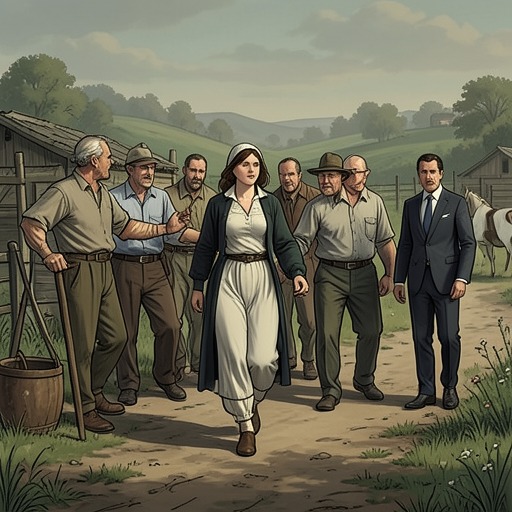
Danita's Farm Turnaround
The Vampire Prince’s BrideDanita's Farm Turnaround marks the decisive reversal from inherited debt and agricultural ruin toward solvency, productive work, and temporary personal independence. When Danita explains that her uncle's debt has been imposed on her, Ryan and Killian respond not by demanding her body as payment but by giving her the resources to confront McGrath and restore the farm. The event therefore changes more than the farm's finances: it briefly replaces coercive dependency with practical agency, while revealing that money can function both as a liberating gift and as part of a wider economy of control.
Causes and Financial Crisis
Danita's crisis begins with an obligation she did not create. She owes McGrath's Leopard-connected operation a total of five hundred thousand dollars, including a fifty-thousand-dollar down payment due within three months, even though the debt originally belonged to her uncle. The farm itself is not valuable enough to cover that demand, and Danita has already investigated whether oil or another hidden resource might make the land profitable. Her mortgage application has also failed, a result Killian attributes to McGrath's influence over the bank. The apparent offer of a way forward is therefore shadowed by the possibility that McGrath wants the land rather than merely repayment.
Ryan and Killian recognize that the debt is not an ordinary financial liability. It is a mechanism by which McGrath can dictate Danita's future, and Danita fears that the promised help may be another trick that increases what she owes. The two Bears reject that interpretation. Ryan asks for the exact amount and deadline, while Killian assures Danita that she need not worry about the money. Their intervention begins as a response to a specific figure and a specific deadline, not as an abstract promise of protection.
The Gift and the Farm's Reconstruction
Ryan gives Danita one hundred thousand dollars in cash on the same day she discloses the debt. He presents it as a gift, and the gesture is reinforced by Ryan and Killian's evident hostility toward McGrath; they do not appear to be secretly cooperating with the man who has trapped her. The money gives Danita immediate room to act. She pays McGrath half of the cash at once, then adds another ten thousand dollars to purchase two additional months before monthly repayments begin. The payment does not erase the larger debt, but it converts an immediate threat into a longer interval in which the farm can produce income.
Danita invests the remaining money directly in the property instead of treating the gift as temporary relief. She seeds hay in the flat fields beside the tree line and buys six alpacas—five females and one male—creating the beginnings of a viable herd. She also plants a vegetable garden. These choices make the turnaround material and specific: the rescue is expressed through fields, livestock, and food production rather than through an ungrounded promise that the farm will somehow recover.
The physical condition of the property improves in less than a week. The barn is patched, the house becomes livable, and Danita is positioned to start earning returns from the land. The narrative presents this as a genuine change in value: the farm moves from an inherited burden that cannot support repayment to an enterprise with the possibility of sustaining its owner. Danita's life appears to have turned around because the gift has been converted into labor, infrastructure, and future income.
Relief Under Continued Coercion
The turnaround does not end McGrath's power. Just when Danita's circumstances seem secure enough to support optimism, a package arrives from him. Inside is a pomegranate-red corset with a short, lacy skirt, accompanied by a note. The clothing makes the unresolved nature of the rescue visible: although Danita now has money and a functioning farm, McGrath continues to frame her body as an asset within the debt relationship. Her fear and sickness at the package show that the financial problem has been separated from, but not eliminated by, the threat of sexual coercion.
Killian's response confirms how dangerous the remaining obligation is. When Ryan suggests fleeing or killing McGrath, Killian refuses assassination because doing so would require paying double Danita's ransom to the Leopard to keep them alive. Instead, he says he has made an agreement to buy Danita from McGrath. McGrath gives them a month to produce Danita's debt plus an additional two hundred and fifty thousand dollars, promising to leave her alone forever if they succeed. The farm's recovery thus becomes part of a second, larger struggle: Danita and the Bears must use the new livelihood to resist a system that treats debt as ownership.
Exchange, Agency, and Narrative Significance
The event's central exchange is deliberately ambiguous. Ryan's one hundred thousand dollars is called a gift, unlike McGrath's demand, which is an inherited debt enforced through threats and bodily implication. Yet the gift also binds Danita to a plan involving repayment, land, and protection. Its moral force comes from the difference between consent and coercion: Ryan and Killian offer resources and care, while McGrath converts financial vulnerability into a claim over Danita's person.
The farm's reconstruction also changes Danita's position in her relationships with the two Bears. Their attraction is apparent, but their conduct consists of soft caresses, foot rubs, cooking, and other forms of courtship rather than threats. As the farm improves, Danita becomes less afraid that they will demand her body as payment. The distinction matters because the turnaround gives her time to recognize desire without confusing it with forced repayment. She remains inexperienced and frightened by the possibility of acting on her fantasies, but the restored farm gives her a material foundation from which choice can exist.
The event is therefore a temporary victory rather than a final emancipation. Danita pays McGrath, plants the fields, acquires alpacas, repairs the barn, and makes the house livable; each action pushes the story toward self-sufficiency. But the corset and the later ransom agreement expose the limit of that success. Economic recovery can make resistance possible, yet it cannot by itself dissolve a power structure that claims the land, the debt, and the woman attached to it. Danita's farm turns around, but the struggle over who controls Danita remains active.